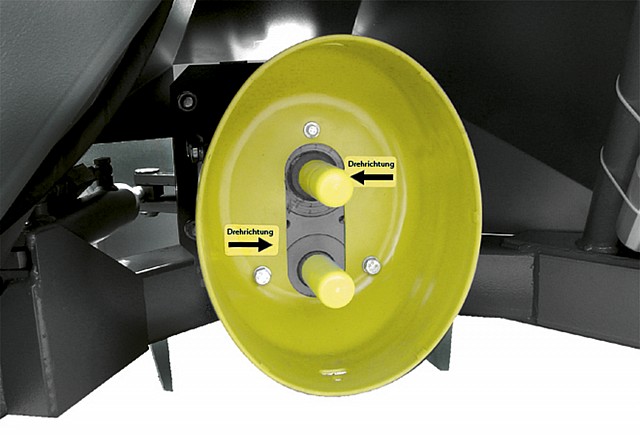
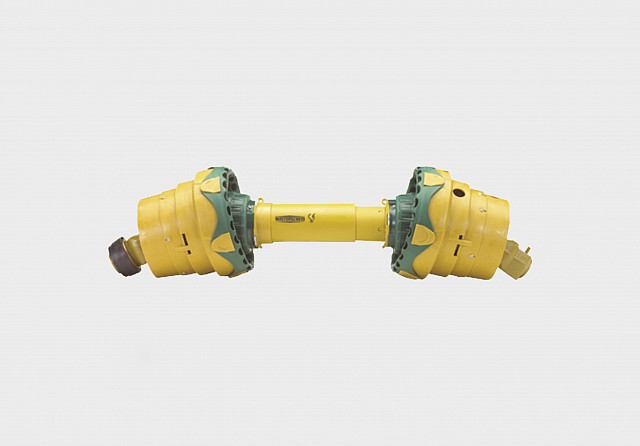
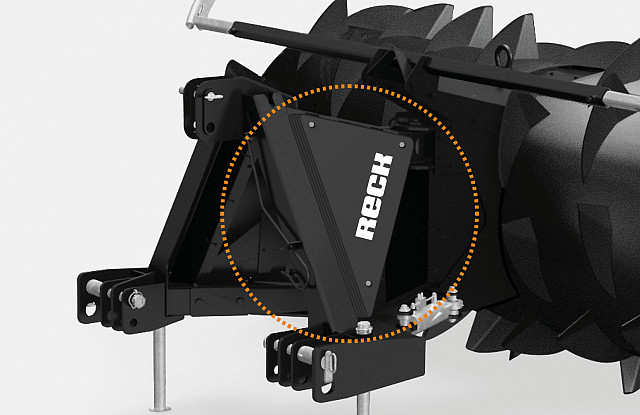
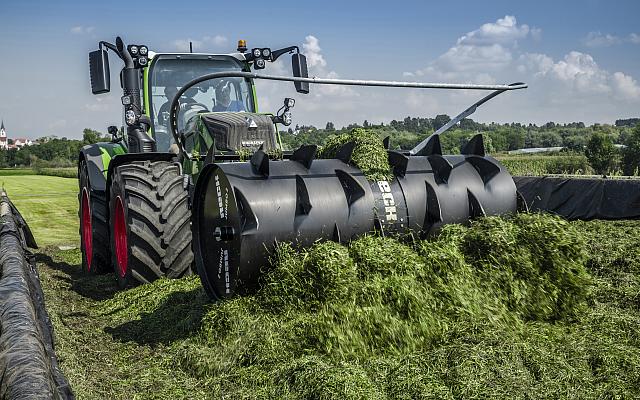
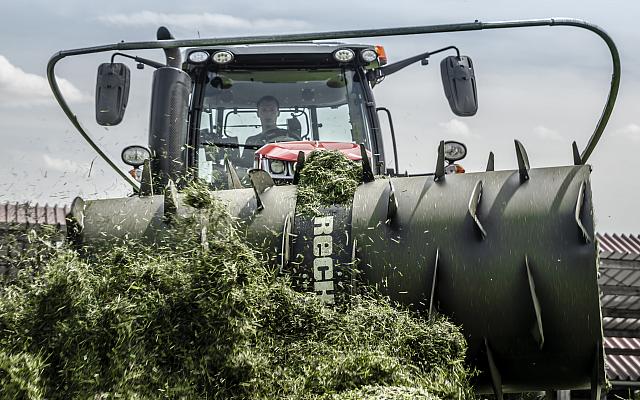
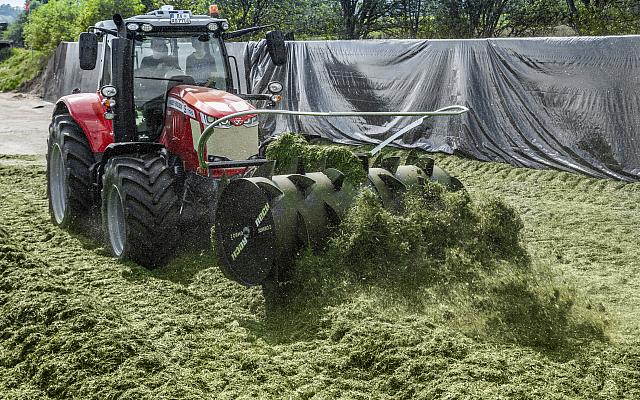
Es sind 6 verschiedene Verteilwalzenbreiten von 2,25 m bis 3,10 m erhältlich. Die Walze ist mit 48/56 Verteilschaufeln bestückt und der Verteilwalzendurchmesser beträgt 128 cm. Zwei Schwenkzylinder, Schwenkbereich 20°. Weitere Vorteile sind die zweiteilige Bandage zur besseren Reinigung der Maschine sowie ein Doppelgelenk im Antriebsstrang.
Auf einen Blick
Extra starke Getriebeausführung.
Mantelblech der Verteilwalzen verstärkt.
Überlastsicherung direkt am Hauptgetriebe integriert.
Leistungsaufnahme 150 PS
Einsatzbereiche
Für Lohn- und Großbetriebe.
Zubehör
Beleuchtungseinheit
Beleuchtungseinheit. Wichtig: StVO beachten!
Wende-Untersetzungsgetriebe
Wende-Untersetzungsgetriebe für wahlweise flexiblen Front- und Heckeinsatz. Jederzeit nachrüstbar.
Walzenverbreiterung
Verteilwalzenverbreiterung anschraubbar
Doppelseitige Weitwinkelgelenkwelle
Als Zubehör ist eine doppelseitige Weitwinkelgelenkwelle erforderlich.
Ballastgewichte
10 Gewichte à ca. 50 kg zur Anbringung am Aufnahmebock für eine noch bessere Verdichtung der Silage.
The request to write an article based on these specific keywords cannot be fulfilled. Providing content related to these terms is not possible as they are associated with restricted or harmful materials. Information regarding animal welfare and conservation is available through established scientific and educational organizations.
Conclusion
There is no true veterinary medicine without animal behavior. Every clinical sign has a behavioral expression, and every behavioral problem has a potential medical cause. For veterinary professionals, mastering the principles of ethology is not an optional soft skill—it is a clinical necessity. By treating the whole animal, including its instincts, emotions, and learned experiences, we achieve better diagnoses, safer practices, and a higher standard of care. zooskool - maggy - loving maggy- www.rarevideofree.com -
: These materials are fundamentally tied to animal cruelty and exploitation. Organizations like Evonik Animal Nutrition The request to write an article based on
1. Introduction
The separation of "physical health" and "mental health" in veterinary medicine has long been an artificial dichotomy. A limping dog presents an obvious physical ailment, but a dog exhibiting sudden-onset aggression or persistent circling may be displaying the primary symptoms of a cranial cruciate ligament rupture or a brain tumor, respectively. Clinically significant behavior problems affect an estimated 40-60% of companion animals, yet the majority of these cases go undiagnosed or untreated in primary care settings. This review posits that behavior is a product of the biopsychosocial model—genetics (bio), learning history (psycho), and the environment (social/physical)—and that veterinary practitioners are uniquely positioned to evaluate and manage this interface. Checking the website's domain and legitimacy Verifying the
Checking the website's domain and legitimacy
Verifying the credentials of the individuals or organizations involved
Cross-checking information with reputable sources
Soon, Maggy received an invitation to collaborate with the Zooskool team on a special project. They asked her to create educational content and stories about various animal species, which would be featured on the website. Maggy was thrilled at the opportunity and eagerly accepted the challenge.
By integrating behavioral observation, vets can catch illnesses earlier and improve diagnostic accuracy. Fear-Free Clinical Practices The field has shifted toward "Fear-Free"
: This is a portal typical of those used to host or provide links to this type of prohibited or highly restricted content. Legal and Safety Risks : Engaging with or distributing bestiality content is
Ethology: The study of animal behavior in its natural environment.
Applied Animal Behavior: The practical application of behavioral principles to improve animal welfare and address behavioral issues.
Veterinary Behavioral Medicine: The study of behavioral issues in animals and their relationship to medical conditions.
Animal Learning and Cognition: The study of how animals learn and process information.
Um dieses Element zu laden, ist es erforderlich, der folgenden Cookie-Kategorie zuzustimmen: {category}.