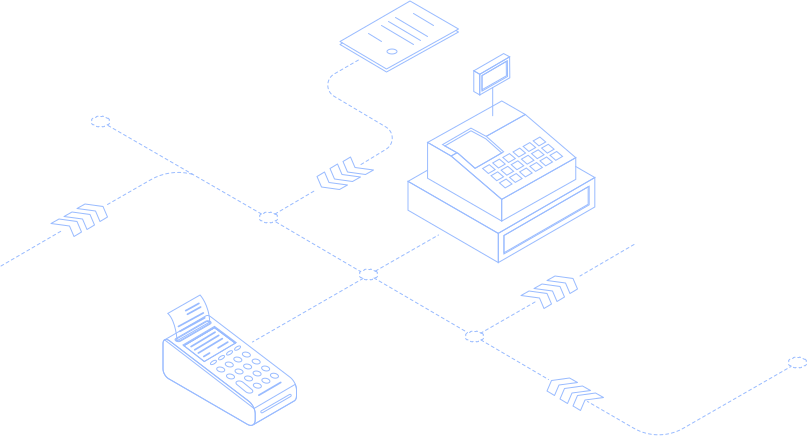

Ускоряет торговые процессы, автоматизируя
и упрощая
деятельность хозяйствующих субъектов

Отменены 9 форм бумажной
отчетности
Исключены центры технического обслуживания
Применение фискального накопителя (аналог ЭКЛЗ) с возможностью его самостоятельной замены 1 раз в 3 года для плательщиков патента, а также сферы услуг
Контролируйте свой бизнес в режиме реального времени: следите за своими оборотами и показателями
Торговое онлайн-взаимодействие создает прозрачные отношения между бизнесом и налоговым органом
Зарегистрировать ККТ без визита в территориальный налоговый орган можно онлайн при наличии электронной подписи.
Регистрация занимает 5 минут.
В заявлении нужно указать:

For standard Nintendo 64 emulation, you generally do not need a BIOS file. Most popular emulators like Project64 and RetroArch (using the Mupen64Plus-Next core) use High-Level Emulation (HLE) to recreate the console's behavior without requiring the original firmware.
💡 Pro-Tip: If you see a "BIOS" folder in an emulator and it's empty, don't panic. It is likely intended for the 64DD or other systems that do require firmware (like the PS1). Your standard N64 .z64 or .n64 game files will work fine without it. nintendo 64 bios
Unlike the PS1 or Saturn, the N64 boots games almost instantly. There’s no startup logo, no OS menu, and no licensing screen. Why? Because Nintendo designed the console to boot directly from the game cartridge. For standard Nintendo 64 emulation, you generally do
Step 3: The IPL (Initial Program Loader) Once the CIC handshake is successful, the PIF copies a small bootloader (the IPL3) from the cartridge into the console’s memory. The CPU then jumps to that code, and the game begins. Project64, Mupen64Plus, RetroArch cores (e
Boot Intros: Some emulators allow for an optional BIOS file just to display the original startup logo and animation.
Проверьте подлинность фискального документа. Введите номер фискального накопителя (ФН), номер фискального документа (ФД) и значение фискального признака (ФП), которые указаны на чеке. Для корректной проверки чека необходимо заполнить все поля на форме.
Чтобы проверить наличие ККТ в реестре, выберите модель и введите заводской номер ККТ, который указан на задней стороне
Чтобы проверить наличие ФН в реестре, выберите модель и введите заводской номер ФН, который указан на задней стороне
For standard Nintendo 64 emulation, you generally do not need a BIOS file. Most popular emulators like Project64 and RetroArch (using the Mupen64Plus-Next core) use High-Level Emulation (HLE) to recreate the console's behavior without requiring the original firmware.
💡 Pro-Tip: If you see a "BIOS" folder in an emulator and it's empty, don't panic. It is likely intended for the 64DD or other systems that do require firmware (like the PS1). Your standard N64 .z64 or .n64 game files will work fine without it.
Unlike the PS1 or Saturn, the N64 boots games almost instantly. There’s no startup logo, no OS menu, and no licensing screen. Why? Because Nintendo designed the console to boot directly from the game cartridge.
Step 3: The IPL (Initial Program Loader) Once the CIC handshake is successful, the PIF copies a small bootloader (the IPL3) from the cartridge into the console’s memory. The CPU then jumps to that code, and the game begins.
Boot Intros: Some emulators allow for an optional BIOS file just to display the original startup logo and animation.

2005-2026 ФНС России
 на сайт фнс россии